Climate scientists
Tyler Cowen writes:
I’ve stressed on MR many times that climate change is not in fact an existential risk, but it could be a civilization-destroying risk if we just keep on boosting carbon emissions without end. I don’t know a serious scientist who takes issue with that claim.
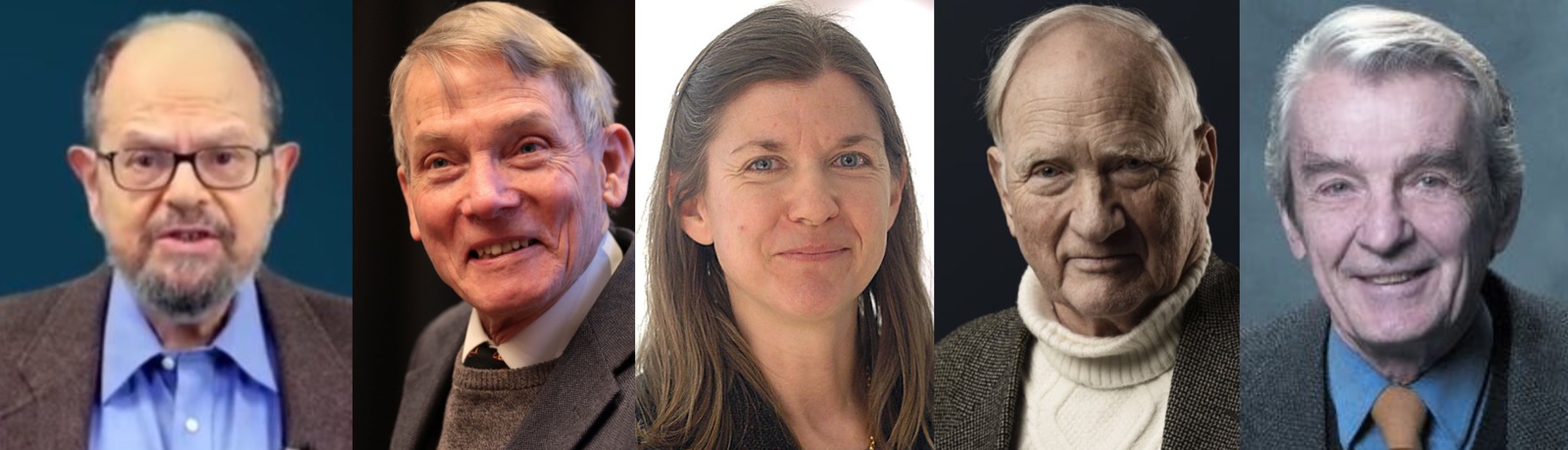
A few serious scientists: Richard Lindzen, Will Happer, Judith Curry, John Clauser, Ivar Giaever
Dear Tyler,
There are, in fact, a few serious scientists who take issue with that claim, and you should meet some of them. My response is in three parts, plus information about a class I teach and a call for a proper debate:
Part I: Over 9,000 scientists with PhDs take issue with that claim
First, a group of volunteer scientists put together a list of over 31,000 scientists who signed a petition asking for people who agreed with the statement:
There is no convincing scientific evidence that human release of carbon dioxide, methane, or other greenhouse gases is causing, or will, in the foreseeable future, cause catastrophic heating of the earth’s atmosphere and destruction of the earth’s climate. Moreover, there is substantial evidence that increases in atmospheric carbon dioxide produce many beneficial effects upon the natural plant and animal environments of earth.
More than 9,000 people with PhDs signed that petition. Many more are working scientists with master’s degrees. Feel free to discount those numbers by some amount if you wish, but those signatures are just a sample of a much larger number. Other lists include …
- members of the CO2 Coalition
- scientists who have signed the Clintel Declaration
- Brazilian scientists who signed a statement to the government of Brazil
- a list on Github (don’t know anything about this one)
- More Than 700 International Scientists join a senate report Over Man-Made Global Warming Claims
Of course, numbers of “believers” don’t determine scientific outcomes, consensus is not how science is done, but I’m responding here to a specific claim and want to introduce you to some people you don’t know.
Part II: A curated list of serious scientists with PhDs who take issue with that claim
Total so far: 262
These people with Ph.Ds have all gone on record saying that CO2 is beneficial and is not causing any degree of worrying climate change, even in the extreme limit that humans could produce. I have validated their credentials. Some of them probably signed the above petition. Those still alive (most) are actively helping people learn that today’s climate science is mostly propaganda, lies, and bad models.
I'm leaving out working scientists …
- with master's degrees (too many to count).
- with MDs (also too many).
- who can't afford to go on the record in fear of losing their jobs (far too many).
- who asked to be left off for professional reasons but said they support the idea.
To be honest, there are many more PhD’d scientists than I can document properly. In case you think MIT PhDs get extra credit, they are in blue (with apologies to those from Princeton, Cal Tech, and Stanford) and Nobel laureates in red:
- Aitkin, Don — political science, University of Canberra
- Alexander, Ralph — physics, Oxford University
- Alexandris, Stavros — agricultural sciences, Agricultural University of Athens
- Ault, Earl — plasma physics, UCLA
- Baeuerle, Patrick — biology, Universities of Konstanz and Munich
- Bailunas, Sallie — astrophysics, Harvard University
- Balino, Jorge Luis — nuclear engineering, Instituto Balseiro, Argentina
- Ball, Tim (dec) — geography and historical climatology, Queen Mary University, London
- Bednyagin, Denis — economics of innovation in energy, Swiss Federal Institute of Technology Lausanne (EPFL)
- Bengtsson, Lennaert — meteorology, Stockholm University, former director of the Max Planck Institute for Meteorology in Hamburg
- Berenson, Paul C. — physics, MIT
- Bergholz, Werner — semiconductor physics, Jacobs University Bremen
- Berkhout, Guus — physics cum laude, Delft University
- Best, Clive — high energy physics, University of Liverpool
- Bhattacharyya, Samit — nuclear engineering, University of Wisconsin, Madison
- Billman, Ken — physics MIT, NASA, National Academy of Sciences
- Blaisdell, Charles — chemical engineering, University of Iowa
- Blakely, Philip — molecular biology, Keele University, UK
- Bohn, Edward — nuclear engineering, university of Illinois
- Bovy, Arnold — heat transfer, RWTH Aachen, Germany
- Boyce, Matt — geology, UAitkin, Don — political science, University of Canberra
- Alexander, Ralph — physics, Oxford University
- Alexandris, Stavros — agricultural sciences, Agricultural University of Athens
- Ault, Earl — plasma physics, UCLA
- Baeuerle, Patrick — biology, Universities of Konstanz and Munich
- Bailunas, Sallie — astrophysics, Harvard University
- Balino, Jorge Luis — nuclear engineering, Instituto Balseiro, Argentina
- Ball, Tim (dec) — geography and historical climatology, Queen Mary University, London
- Balling, Robert — geography, University of Oklahoma
- Bednyagin, Denis — economics of innovation in energy, Swiss Federal Institute of Technology Lausanne (EPFL)
- Bengtsson, Lennaert — meteorology, University of Sweden, former director of the Max Planck Institute for Meteorology in Hamburg
- Berenson, Paul C. — physics, MIT
- Bergholz, Werner — semiconductor physics, Jacobs University Bremen
- Berkhout, Guus — physics cum laude, Delft University
- Best, Clive — high energy physics, University of Liverpool
- Bhattacharyya, Samit — nuclear engineering, University of Wisconsin, Madison
- Billman, Ken — physics MIT, NASA, National Academy of Sciences
- Blaisdell, Charles — chemical engineering, University of Iowa
- Blakely, Philip — molecular biology, Keele University, UK
- Bohn, Edward — nuclear engineering, university of Illinois
- Bovy, Arnold — heat transfer, RETH Aachen, Germany
- Boyce, Matt — geology, university of West Virginia
- Brady, Howard Thomas — Antarctic science, University of Northern Illinois
- Briggs, William — mathematical statistics, Cornell University
- Burns, Tony — chemistry, University of New South Wales
- Buson, Christian — agronomy, L'Institut Agro Rennes-Angers, France
- Bye, Erik — physical chemistry, University of Oslo, Norway
- Camp, Sharon — analytical chemistry, Georgia Tech
- Carlin, Alan — economics, MIT
- Carr, John — physics, Imperial College, London
- Carter, Robert — paleontology, University of Cambridge
- Cerveny, Randy — geography, Arizona State University
- Chambers, Kent A. — chemistry, Hardin Simmons University
- Chiaudani, Alessandro — agriculture, Università di Chieti-Pescara, Italy
- Chilingarian, George — petroleum engineering, University of Southern California
- Christy, John — atmospheric sciences, University of Illinois, Distinguished Professor of Atmospheric Science and Director of the Earth System Science Center at The University of Alabama in Huntsville
- Clark, Ian — Earth science, Université de Paris-Sud, Orsay
- Clark, Roy — chemical physics, University of Sussex, UK
- Clauser, John — physics, Columbia University, Nobel prize in physics
- Clough, Charles — atmospheric science (plus Th.D.), retired meteorologist
- Clukey, Eric — geotechnical engineering, Cornell
- Cohen, Roger (dec) — physics, Rutgers
- Collum, David — chemistry, Columbia University
- Connolly, Michael — spectroscopy, Trinity College, Dublin
- Connolly, Ronan — computational chemistry, University College, Dublin
- Cooper, Douglas — Engineering, Harvard University
- Cripwell, F. James — physics, Cavendish Laboratory, Cambridge
- Crockford, Susan — biology, University of British Columbia
- Cronin, Matthew — biology, research professor University of Alaska Fairbanks
- Cullen, Andrew — geography, University of Oklahoma
- Curry, Judith — geophysical sciences, University of Chicago
- D'Alonzo, Raphael — analytical chemistry, University of Massachusetts Amherst
- de Freitas, Chris (dec) — climatology, University of Queensland, Australia
- de Lange, Cornelis Andreas "Kees" — chemistry, University of Bristol
- de Lange, Willem — earth sciences, University of Waikato, New Zealand
- de Waart, Jules — Earth science, University of Amsterdam
- Debertin, David — Agricultural Economics, Purdue University
- Delibero Angelo, Johnson — nuclear technology, materials science, University of São Paulo
- Derakhshani, Maaneli "Max" — physics, University of Utrecht
- Don Easterbrook — geology, University of Washington
- Doshi, Tilak — Economics, University of Hawaii/East West Centre
- Douglas, Art V. — atmospheric sciences, Creighton University
- Drake, James F. — atmospheric sciences, The Aerospace Corporation
- Du Berger, Reynald — Geophysics emeritus, Université du Québec à Chicoutimi
- Duffy, Geoffrey G. — chemical and materials engineering, University of Auckland
- Dyson, Freeman (dec) — received 20 honorary PhDs and was a vocal skeptic of AGW
- Enstrom, James — physics, Stanford
- Everett, Bruce — economics, Fletcher School at Tufts
- Everett, John — oceanography/systems analysis, Florida State University
- Farona, Michael F. — chemistry/biochemistry, University of Akron and UNC Greensboro
- Felicio, Ricardo Augusto — physical geography, University of São Paulo
- Firth, Brian — fluid dynamics, Oxford University
- Fournier, Joseph — physical chemistry, University of Calgary
- Frank, Neil — meteorology, Florida State University; former director of the National Hurricane Data Center
- Frank, Pat — physics, Stanford Linear Accelerator
- Frauenfeld, Oliver — environmental sciences, University of Virginia, contributing author IPCC 2007
- Fricke, Martin — physics, Oak Ridge National Laboratories
- Friis-Christensen, Eigil (dec) — geophysics, University of Copenhagen
- Fulks, Gordon — physics, University of Chicago
- Furfari, Samuel — energy, University of Brussels
- Gannon, Terry — device physics, University of California at Santa Barbara
- Gee, David — geology, Uppsala University, Sweden
- Gerhard, Lee — geology emeritus, University of Kansas
- Gerry, Edward — nuclear engineering, MIT
- Giaever, Ivar — physics, RPI, Nobel prize in physics
- Glatzle, Albrecht — plant nutrition, University of Hohenheim, Germany - Retired Director of Research of INTTAS Paraguay
- Goklany, Indur — electrical engineering, Michigan State University, IPCC participant turned critic
- Goldschmidt, Victor — mechanical engineering, Purdue University
- Gonzalez, Guillermo — physics/astronomy, Iowa State University
- Gray, Gary O. — chemistry, Southwest Baptist University
- Gray, Thomas B. — meteorology, Florida State University
- Gray, Vincent (dec) — physical chemistry, Cambridge University
- Gray, William (dec) — geophysical sciences, University of Chicago
- Green, Kenneth P. — environmental science, UCLA
- Gulberg, Lawrence — Analytical Chemistry, University of Washington
- Hammel, Ernst — Nuclear Physics, University of Vienna
- Hansen, Jens Morten — geology, University of Copenhagen
- Happer, Will — physics emeritus, Princeton
- Harde, Hermann — experimental physics, University of Kaiserslautern
- Harris, Stuart Arthur — geology, Queen Mary University, London
- Hayden, Howard "Cork" — physics emeritus, University of Connecticut
- Higginbotham, Joseph — physics, University of Toledo
- Hogan, C Michael — physics, Stanford University
- Hohenberg, Charles — physics, University of California Berkeley
- Holmes, Robert Ian — climate mitigation, Federation University, Australia
- Humlum, Ole — glacial geomorphology, University of Copenhagen
- Hunt, William — wildlife biology/geology, NOAA
- Idso, Craig — geography, Arizona State; founder and chairman of the Center for the Study of Carbon Dioxide and Global Change
- Idso, Sherwood — soil science, University of Minnesota
- Islam, Aziz — geology, University of Sheffield
- Itoh, Kiminori — industrial chemistry, University of Tokyo
- Izrael, Yuri — physics, Central Asian State University, Vice-President of the World Meteorological Organization (WMO) and Co-Chair of Working Group II and Vice-Chair of the Intergovernmental Panel on Climate Change (IPCC). He was the IPCC coordinator in the Russian Federation. As part of the IPCC delegation, he received the Nobel Peace Prize in 2007
- Jaworowski, Zbigniew — natural sciences, Warsaw
- Johnston, Jason — economics, University of Michigan
- Kalghatgi, Gautam — aeronautical Engineering, Bristol University
- Kalveks, Rudolph — Theoretical Physics, Imperial College, London
- Khandekar, Madhav — PhD in meteorology, Florida State University
- Keen, Richard — atmospheric sciences, University of Colorado
- Kellow, Aynsley — political studies, University of Otago, IPCC reviewer
- Kelly, Michael Joseph — solid state physics, Cambridge
- Kendrick, Hugh — physics, Cal Tech
- Kilty, Kevin — geophysics, University of Utah
- King, David — seismology, Australian National University
- Klein, Richard E. — engineering, Purdue University
- Koonin, Steven — Theoretical Physics, MIT
- Lama, William — physics, University of Rochester
- Landa, Blanca Parga — School of Naval Architects and Engineers, Technical University of Madrid (UPM).
- Ledger, John — tropical pathology, University of the Witwatersrand, Johannesburg
- Legates, David — climatology, University of Delaware
- Lerche, Thomas — statistics, computer science, and educational design, Faculty of Human Sciences at the University of Regensburg, Germany
- Lewis, Marlo Jr — government, Harvard University
- Lindzen, Richard — applied mathematics, MIT; professor of atmospheric sciences emeritus at MIT
- Lins, Harry — environmental sciences, university unclear, USGS hydrologist
- Linsay, Paul — physics, University of Chicago
- Lloyd, Philip — chemistry, University of Calgary
- Lomborg, Bjorn — political science, University of Copenhagen
- Luning, Sebastian — geology/Paleontology, University of Bremen
- Lynch, William — solid state physics, Princeton & MIT
- MacDonald, Digby — chemistry, University of Calgary
- Madarasz, Frank — condensed Matter Theoretical Physics, University of Alabama at Huntsville
- Maia, Thiago — nuclear physics and astrophysics
- Manheimer, Wallace — physics, MIT
- Mann, Richard — physical chemistry, Princeton
- Manns, Francis T. — geology, University of Toronto
- Marks, Ronald C. — chemistry, North Greenville University
- Masson, Henri — chemical engineering processes, University of Brussels
- McCall, Gene — applied mathematics and plasma physics, Los Alamos National Laboratory, Former Chief Scientist at Air Force Space Command
- McKittrick, Ross — economics, University of Guelph
- McMurtry, Mike — geology, St Andrews University, Scotland
- Mearns, Euan — isotope geochemistry, University of Aberdeen
- Meeus, Ferdinand — chemistry, photophysics, photochemistry, KU Leuven
- Michaels, Patrick (dec) — ecological climatology, University of Wisconsin at Madison; was president of the American Association of State Climatologists and program chair for the Committee on Applied Climatology of the American Meteorological Society
- Mickelson, Edward — chemistry, Rice University
- Miskolczi, Ferenc — atmospheric physics, former NASA Ames Research Center
- Moore, John — economics, University of Virginia
- Moore, Patrick — ecology University of British Columbia
- Moring, Jill — chemistry, University of Connecticut
- Morner, Nils-Axel (dec) — Quaternary Geology, Stockholm University
- Muirhead, Vincent U. — aerospace engineering, University of Kansas
- Mullis, Kary (dec) — biochemistry, University of California, Berkeley
- Nakamura, Mototaka — meteorology, MIT
- Nascimento, Rafaella — chemistry, University of Montreal
- Nichols, Rodney — physics, Harvard; past President and CEO of the New York Academy of Sciences
- Nikolov, Ned — ecosystem modeling, Colorado State University
- Nordangård, Jacob — Technology and Social Change, Linköping University
- Nordin, Ingemar — Philosophy of Science, Lund University
- Ott, Markus — organic chemistry, University of Saarland
- Packham, David — atmospheric science, CSIRO/Monash University
- Parish, Trueman — engineering, Rice University
- Park, Seok Soon — environmental science, Rutgers
- Parmentola, John — physics, MIT
- Peiser, Benny — political science, University of Frankfurt
- Plimer, Ian — Geology at Macquarie University, Australia
- Pochat, Victor — water resources engineering, Universidad del Litoral, Argentina
- Poppe, Hugo (dec) — Climatology, KU-Leuven
- Poyet, Patrice — geochemistry, Université de Nice, France
- Préat, Alain — geology, Université Libre de Bruxelles
- Prestininzi, Alberto — geology, Università di Roma La Sapienza
- Reisman, George — economics, New York University
- Reiter, Paul — medical entomology, Pasteur Institute
- Reitz, Rolf — mechanical and aerospace engineering, Princeton
- Rickard, Terry — Engineering Physics, University of California, San Diego
- Ridd, Peter — physics, James Cook University (was head of physics department before they let him go for expressing his thoughts on climate science)
- Ridley, Matt — biology, Oxford
- Ritchie, Gary — forest biology, University of Washington
- Robinson, Art — biochemistry, University of California San Diego
- Rossiter, Caleb — Policy, Cornell University
- Salazar, Michael R. — chemistry, Union University
- Salby, Murry (dec) — environmental dynamics, Georgia Tech
- Sas, Daryl — biology, Geneva College
- Scafetta, Nicola — physics, University of North Texas, Duke University
- Schernikau, Lars — economics, Technische Universität Berlin, Germany
- Schoneveld, Chris — structural geology, Universiteit Leiden Netherlands
- Segalstad, Tom — geochemistry/geology, University of Oslo, former IPCC expert reviewer
- Seitz, Frederick (dec) — solid-state physics, Princeton
- Sevenhans, Joannes — electrical engineering, KU Leuven
- Shanmugam, Ganapathy — geology, University of Tennessee, Knoxville
- Shaviv, Nir — solar science, Israel Institute of Technology (Technion)
- Sheahan, Tom — physics, MIT
- Simpson, Joanne — meteorology, Florida State University
- Singer, S. Fred (dec) — physics, Princeton
- Skrable, Kenneth — radiology, Rutgers
- Smith, G. LeBlanc — geosciences, CSIRO Australia
- Soepyan, Fritz Bryan — chemical engineering, University of Tulsa
- Soon, Willie — aerospace engineering, University of Southern California
- Spencer, Roy — meteorology, University of Wisconsin, Madison; works for NASA
- Staddon, John — experimental psych at Harvard and MIT; biology emeritus at Duke
- Steele, Charles — economics, New York University
- Steward, Leighton — geology, award-winning geologist/environmentalist
- Stilbs, Peter — physical chemistry, Royal Institute of Technology, Stockholm
- Svensmark, Henrik — physics, Technical University of Denmark
- Tanaka, Hiroshi — Atmospheric energetics, Dynamic meteorology, and Geophysical Fluid Dynamics; Department of Atmospheric Science, University of Missouri-Columbia, USA
- Thomas, Mario — chemistry, Universite Laval, Canada
- Thornton, Charles — structural mechanics, New York University
- Thuene, Wolfgang P. — meteorology, German Weather Service
- Tol, Richard — economics, Vrije Universiteit Amsterdam
- Tolk, Norman — atomic physics, Columbia University
- Tonni, Eduardo — paleontology, University of La Plata, Argentina
- Trevino, Andres — chemical engineering, University of Wisconsin, Madison
- Vahrenholt, Fritz — chemistry, University of Münster
- Van Wijngaarden, William — physics, York University; chair of faculty of science and engineering
- Vinos, Javier — biochemistry, Autonomous University of Madrid; author of Climate of the Past, Present, and Future - a Scientific Debate (the best book on climate ever written)
- Viterito, Arthur — geography, University of Denver
- Vogel, Koen — geology, Penn State
- Walters, William — physical chemistry, University of Maryland
- Ward, Frederick Jr — meteorology, MIT
- Wathelet, Marc — molecular biology, Free University of Brussels
- Watson, Thorpe — Metallurgy & Materials Science, The University of Birmingham
- Wells, William L. — chemistry/chemical engineering, Murray State University
- Whitehouse, David — astrophysics, Victoria University of Manchester
- Wielicki, Matthew — earth science, UCLA
- Wimberley, Terry — ecological studies, Florida Gulf Coast University
- Winters, Terry — chemistry, University of Wales
- Wojick, David — philosophy of science/mathematical logic, University of Pittsburgh
- Wolf, Frederick — physics, Keene State College
- Wolkers, Hans — Physiology/ecotoxicology, Utrecht University
- Young, Stanley — statistics and genetics, North Carolina State University
- Zágoni, Miklós — physics, Hungary (formerly most outspoken Kyoto supporter, reversed to skeptic)
- Zeller, Karl — meteorology, Colorado State University
- Zharkova, Valentina — astrophysics, Main Astronomical Observatory, Kiev, Ukraine
- Zhong, Yong — physics, Monash University, Australia
- Zybach, Bob — environmental science, Oregon State
Those who want to be added — send me your name, department, and university that issued your Ph.D.
You can find plenty of criticism of most of these people online. These are the scientists old enough or brave enough not to be threatened. Calling them names does not delete the importance of their contributions to science. If you don’t know who Giordano Bruno was, that’s exactly my point. Science has a serious credibility problem.
The risk of net-zero
Many of us agree with the statement that going to net-zero via renewables is a threat to civilization as we know it because the math of net-zero doesn’t work, both for economic and ecological reasons. I don’t speak for everyone, and I only have a master’s degree, but I believe most of us agree that a gradual, market-based transition to nuclear energy with no wind, minimal solar, minimal battery storage, minimal regulation, and minimal government subsidies is the best energy policy. Intermittent power makes everyone poorer, especially in Africa. No one should have to suffer from energy poverty. Governments should support the development of fossil-fuel-based grids to provide affordable, reliable baseload power and focus environmental resources on local issues like pollution, spills, cleanups, prevention, etc. Governments should support efforts to build nuclear power plants the market wants, not through subsidies but through reduced regulation and stronger international agreements.
No country, no state, no city, no company, no organization should have a climate policy, because humans can’t affect the climate.
Part III: For further research
There is much more. There are papers, blogs, newsletters, organizations, books, videos, and YouTube channels all dedicated to getting the word out that scientifically, CO2 is not a driver of climate, we are currently in a CO2 famine, and more would be better. CO2 is plant food. It is not pollution. Greenhouses pump in CO2 to about 1,200 PPM to help plants grow. For 200 million years, from 550 million to 350 million years ago, CO2 was in the 2,000 to 8,000 PPM range (up to 20 times higher than today), the earth was generally (but not always) warmer than today, plants exploded, and life flourished. Even back then, CO2 drove plant growth but not the climate.
Climate science master class with David Siegel
The class is now evergreen — you can join any time. See the class pagefor details and registration.
An important climate debate
We would be happy if you could help arrange a serious, long-format debate on the science. We are eager to debate. I think you’ll find precious few mainstream climate scientists interested in debate. The IPCC certainly isn’t.
So, Tyler, if you’d like to have a conversation with any of these people, let me know and I’ll set it up. All of us could read and learn more widely on many topics, as you’ve explained so many times. I’d love to help you do that.
Sincerely,
David Siegel